
A Hole in the Escalation Trap
CNI adds a missing psychological layer.

Those paying close attention to Iran will have heard political scientist Robert Pape discuss his escalation theories early, often, and at great length. He has become extremely popular for explaining how trump has walked the American military and world economy into a trap.
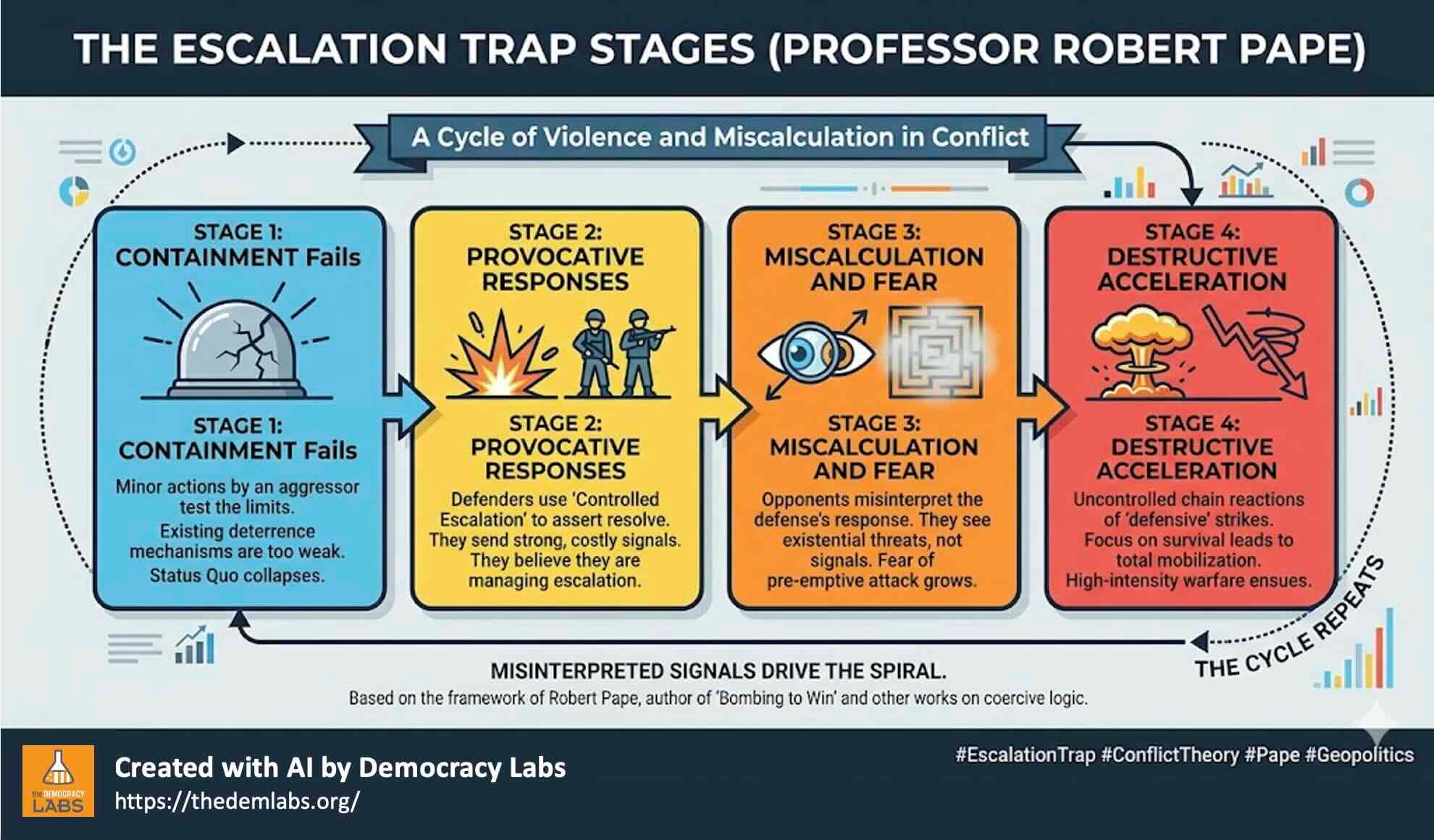
For the unfamiliar, Professor Pape’s “Escalation Trap” is about how a country’s use of limited strikes, the retaliation, and political pressures sets them on an ever-increasing path of violence, conflict, and war, which makes escalations such as ground invasions almost inevitable.
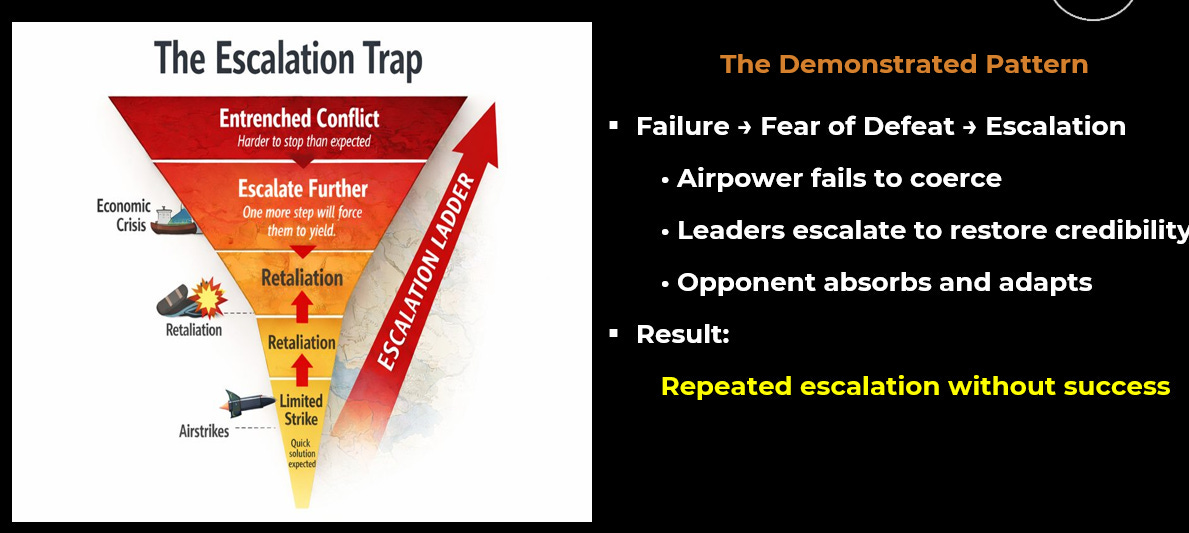
However, to set minds at ease about a ground war, the narcissist bully has failed so spectacularly with Iran that he has lost all taste for fighting someone who can fight back. Now, he just wants to declare victory, quietly fade into the bushes, and then sneak out and attack some big mean country like Cuba to make himself feel like a big boy, but as Professor Pape shows using political science models, he’s trapped.

History
Frankly, it was surprising the theory wasn’t familiar because it’s catchy and logical, and I closely followed Iraq War I, II, and the Afghan war. As someone well-informed about the Middle East via an international relations degree and lifelong study, one would think it would have come up, right?
Professor Pape, on the other hand, has been teaching similar theories since the 1990s.
A proto-model theorized that bombing and punishment rarely forced a surrender unless the enemy was denied the ability to keep fighting. (Iran fail 1? ✅).
That theory was later applied to modern conflicts where limited airstrikes created expectations of success, but when those overly optimistic results don’t appear (Iran fail 2? ✅), …
…leaders often escalate instead of stopping (Iran fail 3? ✅ish!), because they can’t accept a failure (Iran fail 4? ✅).
Hence, “It’s a trap.”
Surprisingly, the reason I had no memory of the “escalation trap” is because the term is new. It is a 2026 rebranding of Pape’s theories as applied to trump trapping America and the world into his Iranian situation.
It could also be said that CNI’s April analysis’ Will trump Double Down, Cut and Run, or Both? covered many of the same themes and concepts.
However, “the escalation trap” has now become an influential model that explains why countries become stuck in increasingly costly quagmires. The primary argument is that once a leader commits to action, each step taken raises the political and reputational cost of backing down.
Fear of lost credibility, wasted funds, and political backlash creates a self-reinforcing dynamic that makes off-ramps appear as tight windows, which in turn makes de-escalation seem even more impossible.
Indeed, “the escalation trap” is a powerful theory that makes a lot of rational sense. However, from a CNI perspective, it has a hole because it is based on the incorrect assumption that all leaders act rationally.
Here is where CNI can add value to Pape’s escalation trap, because we know a narcissist’s escalations are driven by their pathology, meaning they are doing what they need to do psychologically to survive rather than being driven by any strategy.
Missing psychological elements
In CNI’s approach, we analyze toxic leadership words and deeds that are traits, tells, and symptoms of narcissists, sociopaths, and psychopaths in positions of power.
Our purpose is to be able to show why rational, intelligent, and clever leaders, educators, and organizers need to psychologically reconfigure their strategic decision-making when dealing with such disordered people, if for no other reason than their own protection.
While Pape’s theory clearly explains escalation when a leader is concerned with their country’s interests, reputation, and geopolitical strengths and strategies, from what I understand so far, it appears to underplay three crucial factors:
Identity-driven escalation
While Pape appears to treat credibility as political capital, CNI views it as psychological survival. For a malignant type of narcissist, humiliation is not only a massive cost, it is an existential threat that could lead to a narcissistic collapse that could end them even among their most cultish supporters.
This dynamic is why any perceived slight can trigger a massively disproportionate escalation. For such toxic predators, backing down is not a strategic loss. It is a psychological threat to their identity. Others fail them all the time, but they have never failed. When that false reality crumbles, know that it is a very psychologically dangerous time for everyone.
No respect for norms
Pape seems to assume that leaders generally respect norms, agreements, and signals, while regular readers of CNI know that all malignant narcissists, sociopaths, and psychopaths will consistently dismiss norms, ignore signals, and break commitments.
They also are known to shift tactics abruptly and often because means rarely matter to them. All that usually matters is getting what they want or need.
These psychological realities create caveats and volatilities that Pape’s model doesn’t seem to anticipate, but in his defense virtually nobody else does either in political science or international relations.
Symbolic or strategic
Pape has described the escalation in trump’s Iran War as largely “instrumental,” which means his escalating strikes are done to show resolve or action or satisfy political pressures rather than to actually achieve anything, such as his lost goal of regime change. Pape also notes that airstrikes alone have never toppled any regime in modern history.
CNI’s strategic nuance explains that for narcissistically disordered leaders, escalation can be a way to assert dominance, punish those who defy them, and/or restore their self-image. While both paths of non-strategic escalations may produce the same empty results, it must be noted that the motivations between the rational and irrational are crucially different.
Faster, dirtier escalations
CNI also adds value by showing why escalations can accelerate beyond what Pape predicts. In his rational leader model, escalation is usually gradual, where the costs and benefits are calculated before each step.
On the other hand, trump’s Iran War itself was a sudden and disproportionate escalation. By adding a CNI lens, we see that this lashing out makes perfect sense for a malignant narcissist who needs to self-soothe and distract from their other vulnerabilities such as affordability and epstein.
In fact, the reason narcissists often escalate too quickly is because their emotional triggers override any strategic caution. In further detail, the sociopathic are said to be more reactionary, while the psychopathic are more willing to take risks with the lives of others. Risks that rational actors would know to avoid because they actually feel empathy and consider the costs to their military and soldiers.
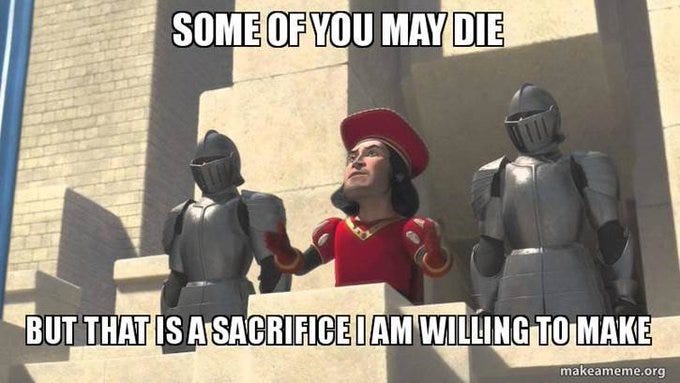
That is what is so fascinating and terrifying about the trap trump has walked us into. He has zero paths to victory and can’t psychologically handle defeat and yet has already lost by his own hand. How will it end?
What’s truly terrifying is if he is allowed to further wield the power of America’s might by his narcissistic whims, the patterns are strong that there will be a lot of lashing out and escalation in his narcissistic rage. This ladder of chaos must be contained!!! It has already been reported that he wanted to drop a nuke on Iran and some generals stopped him. True or not, it’s the scorpion’s nature.
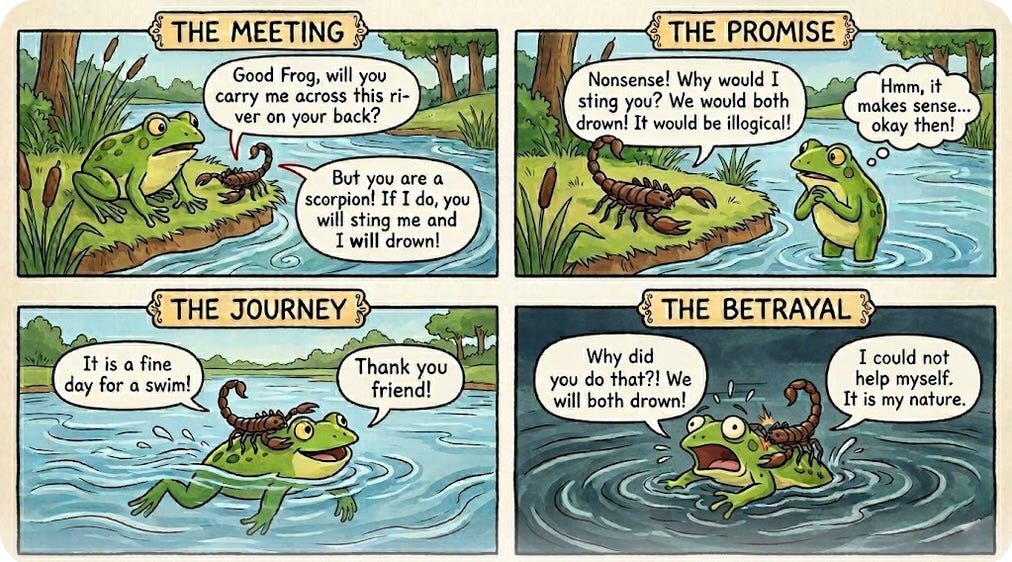
Regardless, these types of irrational people act more rashly, unpredictably, and unconstrained by norms because they possess no respect, empathy, or conscience that holds them back in any way. The escalation trap is still present, but it is entered more quickly and with less warning, for few if any logical reasons. That is where traditional models will miss early signs. They are looking at the rational incentives rather than the psychological triggers.
In the upcoming Part II, CNI will further show how incorporating psychological lenses into escalation models will improve predictions, opportunities for containment, and more targeted crisis management strategies for when the leader caught in an escalation trap is a malignant narcissist, sociopath, or psychopath.
People Say the Most Amazing Things

As regulars have often heard, CNI’s mission and philosophy almost always provides moral clarity. One of my favorite moral questions to ask is, “Does this serve the mission of bringing greater underst…
Counter-Narcissist Database

Please find the updated CNI database. For those unfamiliar with how the library is designed to function, it is important not to t…
I am worried about trump's longing to use a nuke. The sycophants around him are unwilling to defy him, but might if it's their own skins at risk. I can't spend much time thinking about the unthinkable, my mind skips away from it.
Excellent article.